Roofing Invoice vs Roofing Estimate: What's the Difference?
What Is a Roofing Estimate?
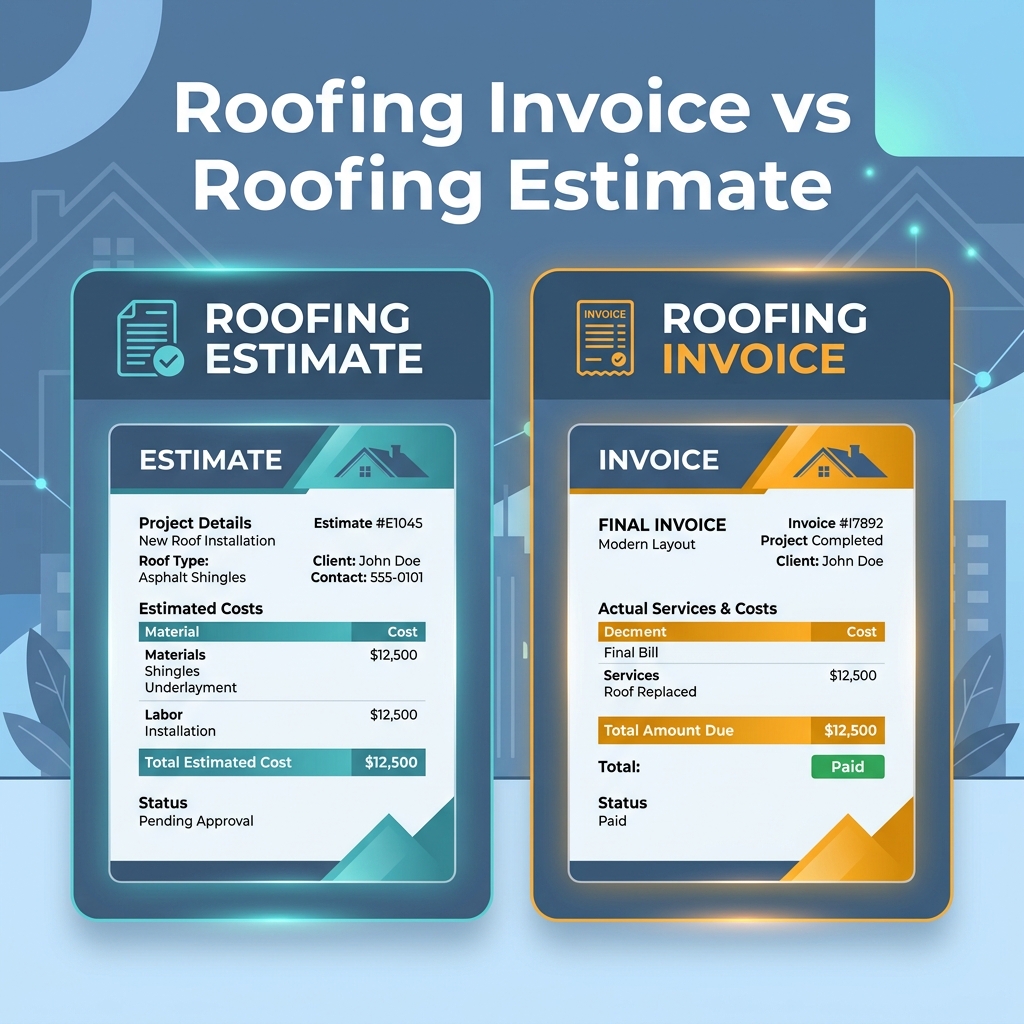
A roofing estimate is a contractor's proposed price for a job, prepared before any work begins, based on a visual inspection or measurement rather than a completed job. It typically includes a projected scope of work, ballpark or itemized material and labor pricing, and a validity period (commonly 30 days) after which the pricing may no longer hold, since material costs and labor availability shift over time.
An estimate answers the question "what will this cost?" , not "what do I owe right now?" Because it's based on visible conditions rather than what's actually found once tear-off begins, most estimates include some margin for the unknown, and reputable contractors state clearly that the number can change if the job reveals additional work (rotted decking, for example, is a common discovery that isn't visible until the old roofing is removed).
What Is a Roofing Invoice?
A roofing invoice is the billing document issued during or after the job requesting payment for work actually completed. Unlike an estimate, it reflects real, itemized quantities , the materials actually installed, the labor hours actually worked, the equipment actually used , rather than projected figures. It also carries the structural elements an estimate typically doesn't: an invoice number, a due date, payment terms, a calculated balance due, and (for a completed job) signatures acknowledging the work was performed and accepted.
An invoice answers "what do I owe now?" , it's the document tied directly to payment, not to a proposal.
Roofing Estimate vs. Roofing Invoice: Side-by-Side Comparison
To understand how a roofing invoice vs roofing estimate compares across operational and legal criteria, examine the detailed line-by-line comparison matrix below:
| Feature | Roofing Estimate | Roofing Invoice |
|---|---|---|
| Issued | Before work begins | During or after work is performed |
| Pricing basis | Projected materials/labor | Actual materials/labor used |
| Legal weight | Generally non-binding proposal | Billing document; becomes binding on acceptance/payment |
| Validity | Time-limited (often 30 days) | No expiration , reflects work already done |
| Contains a balance due | No | Yes |
| Contains signatures | Sometimes, as proposal acceptance | Yes, as work acknowledgment |
| Can change without new paperwork | Yes, within reason, before acceptance | No , changes require a credit, adjustment, or new invoice |
| Used to request payment | No | Yes |
Is a Roofing Estimate Legally Binding?
Generally, no , not on its own. A roofing estimate is typically treated as a proposal, not a contract. It becomes meaningful in a legal sense only once the customer accepts it (often via signature) and it's incorporated into a signed contract, or once work begins on the basis of the customer's approval. Until that acceptance happens, either party can walk away from an estimate without financial obligation.
This matters practically: if a customer later disputes a final invoice by pointing to a lower number on the original estimate, the estimate's stated validity period and its explicit note that pricing may change on inspection (standard practice, not a loophole) are what protect the contractor , provided that language was actually included on the estimate document in the first place.
What Happens When the Actual Job Differs From the Estimate?
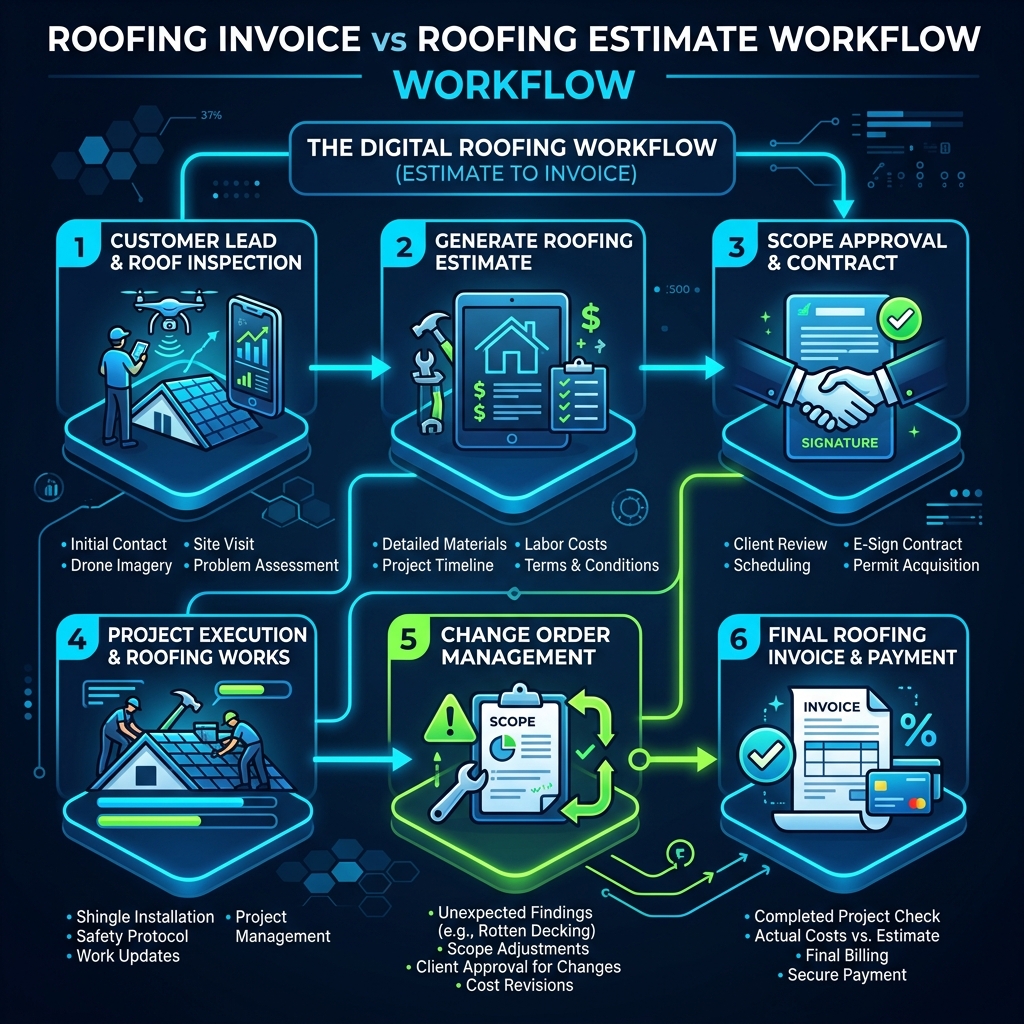
The honest answer: the invoice should reflect what was actually done, and any difference from the original estimate should be documented with a change order , a short, signed addendum describing the additional (or reduced) scope and its cost impact , before the final invoice is issued. Silently invoicing a higher number than the estimate, with no documentation explaining why, is the single most common cause of payment disputes in roofing.
A Well-Run Change-Order Process
- Discovery: The additional issue is discovered (e.g., rotted decking during shingle tear-off).
- Documentation: The damaged area is documented immediately with clear photo evidence.
- Notification: The customer is informed and provided with a revised cost estimate before proceeding.
- Approval: Written approval is captured (even a simple text or email confirmation).
- Invoicing: The change order is added as an itemized line item on the final roofing invoice.
How to Convert a Roofing Estimate Into a Roofing Invoice
Once a job is complete, the estimate becomes the starting point for the invoice , not a separate, disconnected document. Carry forward the customer and property information, then replace every projected figure with the actual figure: real material quantities used, real labor hours logged, any change orders added as their own line items. Add the invoice-specific elements the estimate didn't need , invoice number, due date, payment terms, calculated balance due, and signatures.
Contractors using a shared template or generator for both documents typically find this conversion faster, since the customer and job-detail fields don't need to be re-entered , only the pricing and structural fields (subtotal, tax, deposit, balance due, invoice number, signatures) change between the two document types.
What Does "Roofing Estimate Invoice" Mean?
This is a hybrid term some contractors and software tools use loosely, and it causes real confusion. It generally refers to one of two things:
- (1) An estimate formatted like an invoice: A proposed materials/labor breakdown that looks like an invoice visually but remains legally a non-binding estimate.
- (2) A single combined document for micro-jobs: Used for very small repairs where the estimate and final bill are identical, and one document serves both roles.
It does not mean a single document is simultaneously both a binding invoice and a non-binding estimate , that would create real ambiguity about payment obligation. If a job is large enough to involve any uncertainty in final scope, keep the estimate and invoice as two distinct documents, even if the second is built directly from the first.
Estimates and Invoices in Insurance Claims
Insurance-related roofing jobs typically involve up to three separate documents, which is where confusion is most common:
- The Insurance Adjuster's Estimate: Prepared independently by the carrier using estimating software (like Xactimate) that the contractor doesn't control.
- The Contractor's Estimate: The contractor's own proposed scope and pricing based on physical inspection, which may differ from the adjuster's.
- The Final Contractor Invoice: Billed once work is complete, itemized with reason of repair and before/after photo documentation for the claim file.
When these three numbers don't match , which happens often, since the adjuster's estimate is prepared without the contractor's up-close inspection , the difference is typically resolved through a supplement request to the insurance carrier, backed by the contractor's itemized invoice and documentation, rather than by simply invoicing whatever number the adjuster originally approved.
Common Mistakes When Using Estimates and Invoices
-
1. Sending a document labeled "Invoice" before work has started.
This creates confusion about payment obligation for work that hasn't happened yet , use "Estimate" or "Proposal" until the job begins.
-
2. Never documenting scope changes.
A final invoice that's simply higher than the estimate, with no change order on file, is the fastest way to trigger a dispute.
-
3. Letting an estimate's validity period lapse silently.
If material costs rose after 30+ days, don't invoice the old number without confirming the customer still agrees to proceed at current pricing.
-
4. Treating an accepted estimate as automatically final.
Even a signed estimate should still be followed by a proper final invoice reflecting actual work completed.
-
5. Confusing an adjuster's insurance estimate with contractor pricing.
These are two independent numbers; conflating them causes billing errors on insurance jobs specifically.
Real-World Scenarios
Standard Repair, No Surprises
A contractor estimates a repair at $1,200 based on a ground-level inspection. Once on the roof, the scope matches the estimate exactly. The final invoice mirrors the estimate's line items with no change orders, and the estimate's number and the invoice's number match.
Replacement with Hidden Decking Damage
A contractor estimates a full replacement at $9,500. During tear-off, several sheets of rotted decking are discovered. A change order for $650 in additional material and labor is documented and approved by the customer before continuing. The final invoice totals $10,150, itemized to show the original scope plus the documented change order , not a single unexplained higher number.
Insurance Claim Discrepancy
An adjuster's estimate approves $8,000 for storm damage. The contractor's own inspection finds additional damage the adjuster's estimate didn't capture. The contractor documents this with photos and an itemized supplement request tied to their own estimate, and the final invoice reflects the higher, contractor-documented total pending the carrier's supplement approval , not the adjuster's original number.
Frequently Asked Questions
Draft Itemized Estimates and Invoices in Minutes
Use our free contractor billing tools to generate legally-compliant roofing estimates and invoices for your clients.